During my recent visits to Japan and Iceland, I became curious about the different roles men and women have in their respective country’s workforce. I noticed Iceland was more progressive with more women in leading positions while Japan was a technology-driven economy run by men. In doing my research I found three key differences between Iceland and Japan that affect the gender pay gap: childcare, workplace policies surrounding pay equity, and job distinction by gender.
I hypothesize that these three key differences have led the two highly productive island nations with significant variations in their gender pay equity ranking – Iceland is #1 and Japan is #125 on the World Economic Forum report. Countries that create equal opportunities see stronger economic growth, so what can Japan learn from Iceland to reach its full economic potential?
When it comes to raising children, Icelandic and Japanese societies have different approaches:
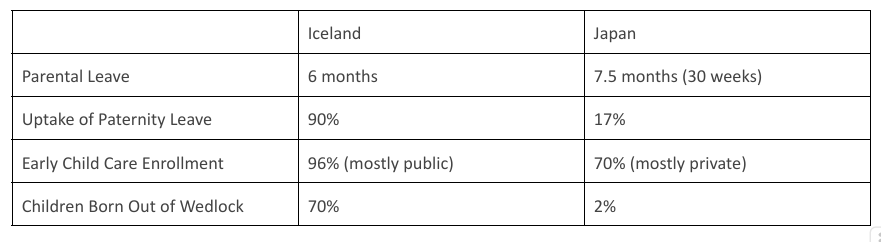
In general, family structures are less conventional in Iceland versus Japan as evidenced by children born out of wedlock. Because of the social structures established, Iceland tends to emphasize gender equality and an equal share of household responsibilities. Icelandic fathers are entitled to less than Japanese ones – who are offered the most generous paternal leave of any nation – but the percentage of fathers who take this leave is higher in Iceland than in Japan. Interestingly, while the proportion of Japanese fathers who take leave is lower than in Iceland, it is worth noting that it has risen significantly – in 2007, only 2% of Japanese fathers took paternity leave whereas now 17% do. Daycare is also more accessible in Iceland than it is in Japan. Iceland spends 1.7% of its GDP on early childcare education while in Japan, most children are enrolled in private education with over two thousand kids on waiting lists. More costly education and limited access means fewer kids are enrolled, which places more demands on families: this usually means mothers stay home and care for the children while fathers focus on their careers. Although much progress has been made, Japanese mothers take on more primary caregiving responsibilities while Icelandic mothers have access to more support.
The participation of men and women at all career levels is impacted by both nations’ distinct workplace policies. In 2018, Iceland introduced a policy that required companies to be evaluated for equal pay across the same positions. Proving equal pay earns companies a certification that has been mandated since 2020; businesses that fail to meet the certification standards are fined daily. Instead of burdening employees to prove inequality in the workplace, this policy holds the employer accountable to prove equality by reflecting on and changing practices that continue to generate more inequality in the economic system. Iceland has also developed a system that requires companies to be transparent with a “traceable pay system,” which makes payment information available to employees who request it. Japan, meanwhile, requires companies to publicly disclose the gap – arguably raising awareness about the issue– but not matching Iceland’s initiative.
These policies impact women as they advance into more senior positions in their careers.
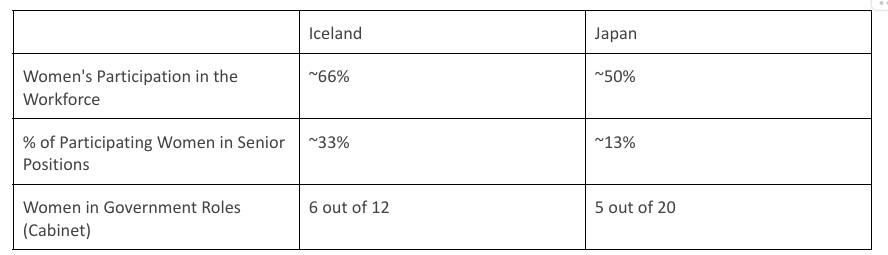
For the past several decades in Iceland, many women have had leading positions such as prime minister and president. While women are underrepresented in both countries, the underrepresentation is more prominent in Japan.
Both Japan and Iceland have work ahead to get the most potential of both genders’ engagement in the workforce. Iceland has been ahead in setting its policies and initiating change and Japan is gradually progressing. Iceland’s openness to unconventional structures in companies and families positively impacts women’s career progression. As Japan sees the economic benefit of female engagement I would expect that their policies and approaches start looking more similar to Iceland. As this happens, Japan will realize more of its economic potential by having more inclusive workforce engagement.

 Navagations